Agent Integration
Stagent integrates both Claude Agent SDK and Codex App Server execution into an operator-facing workspace instead of exposing raw provider runtimes directly. Profiles, tasks, inbox decisions, monitor logs, and usage records all shape how the agent layer behaves.
Key Concepts
- Claude Agent SDK — Embedded Claude runtime with streaming, tool use, and governance callbacks via a polling-based approval pattern.
- Codex App Server — OpenAI runtime with persistent channels, working directory preservation, resumable threads, and provider-aware event streaming. Threads survive disconnection so long-running tasks can resume without losing context.
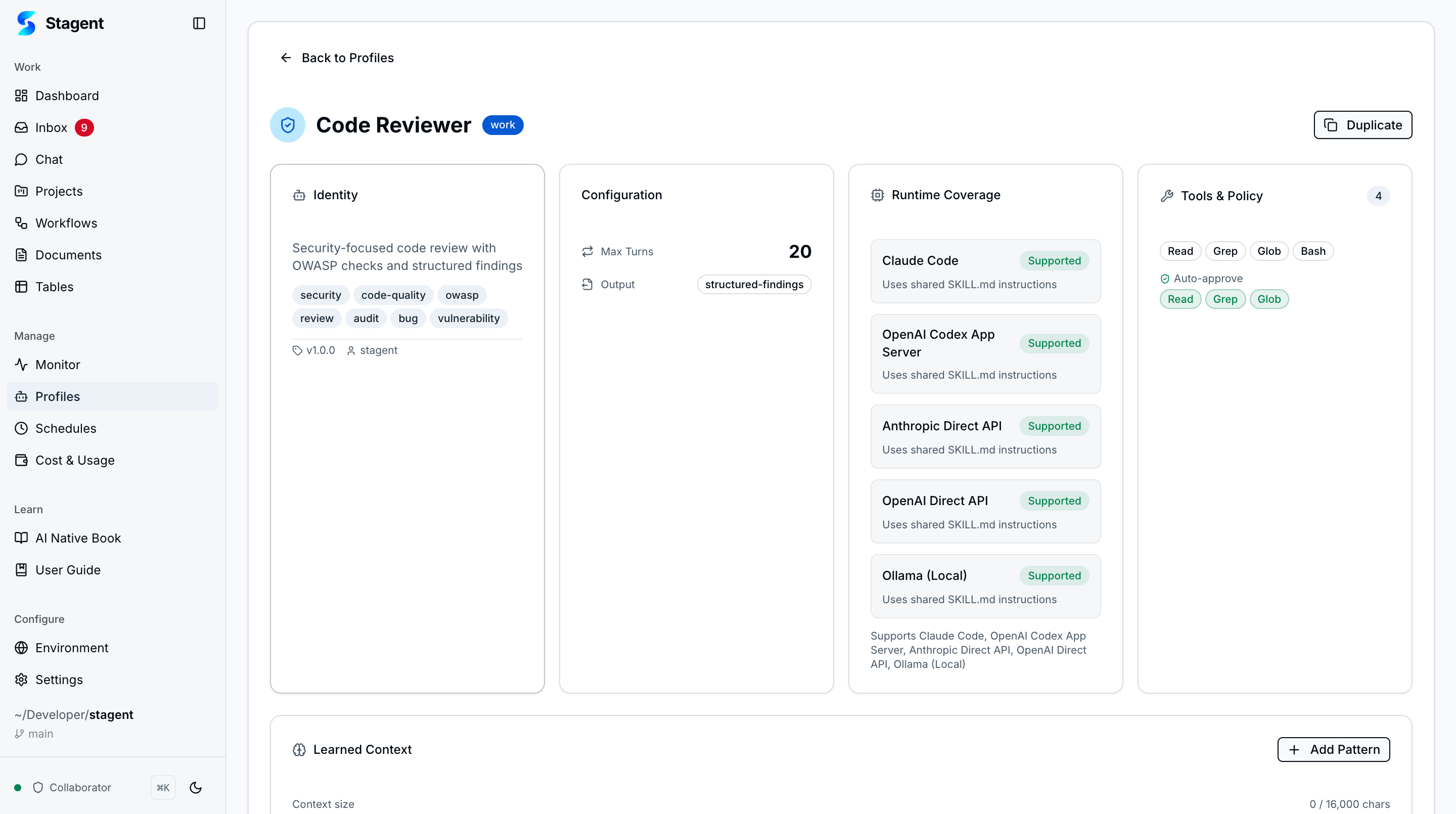
- Profile-Backed Execution — The selected profile defines instructions, tool availability, temperature, max turns, and output format before the run starts.
- Shared Runtime Governance — Tool requests and user questions cross a trust boundary and surface in the inbox for explicit allow or deny decisions.
- Asynchronous Runs — Tasks execute independently of the UI so operators can keep working while agents continue in the background.
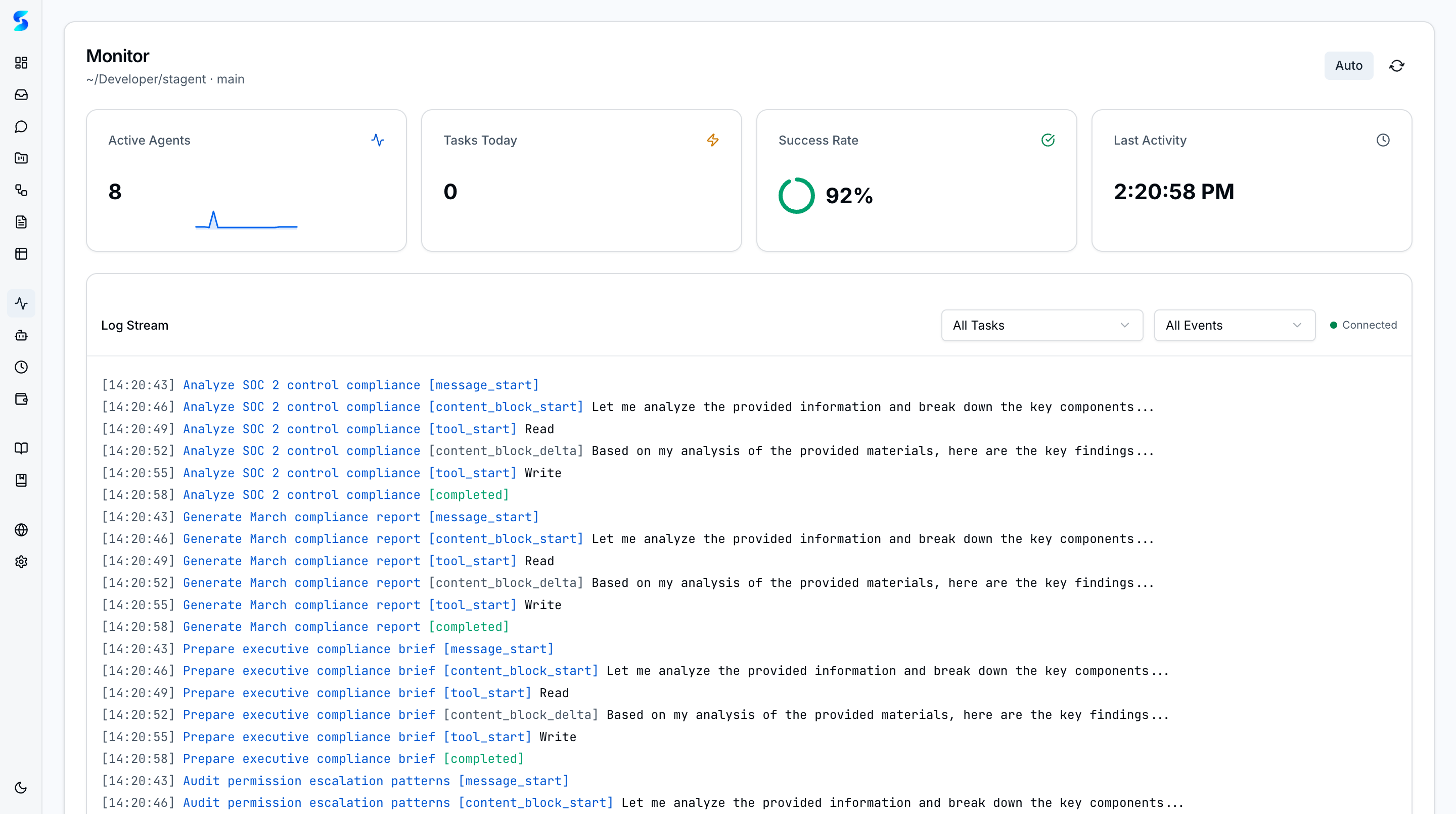
- Agent Logs — Provider-labeled runtime events stream into the monitor for auditability and debugging.
Execution Flow
- An operator creates or queues a task from the dashboard, a project, a workflow, or a schedule.
- Stagent resolves which profile and project context should be applied to the run.
- The execution layer resolves the selected runtime and starts the provider session or thread.
- Tool requests and runtime questions create inbox items when human approval or clarification is required.
- Monitor logs continue updating while the agent waits, resumes, completes, or fails.
- The resulting state remains visible across task detail, project views, inbox history, monitoring, and cost records.
How It Works
Stagent wraps the underlying runtimes with operational primitives that humans can supervise. That wrapper is what turns a raw model session into a governed system: profiles make behavior repeatable, the inbox makes decisions explicit, the monitor keeps execution observable, and the shared usage ledger keeps cost legible.
The integration surface is therefore broader than a single callback. It spans the settings page, profiles catalog, execution dashboard, inbox, monitoring view, and cost dashboard as one coordinated control plane.
Use Cases
Governed Code Deployment
Product Team · Maintaining deployment safety with human oversight
Your code-review profile can read files and run static checks, but a publish step still requires approval. The runtime pauses at the exact trust boundary, and the inbox records the decision before the agent proceeds.
Research with Source Verification
Knowledge Worker · Ensuring agents use credible sources
The agent reaches for a source you do not trust. You deny the tool request, provide a safer alternative, and keep the run grounded in operator-reviewed choices instead of silent retries.
Batch Processing with Session Resume
Developer · Refactoring 50 files without starting over
Your agent fails halfway through a large run. Because the execution record lives inside Stagent’s operational surfaces, you can review the monitor output, inspect the task, fix the issue, and resume from a known state instead of starting blind.
First-Time Agent Delegation
Non-Technical User · Building trust through full transparency
You never have to wonder what the agent can do or what rules it is following. The profile view, inbox, and monitor make the runtime legible enough for a non-developer to supervise confidently.
Related Features
- Human-in-the-Loop — The inbox where permission requests appear
- Monitoring — Real-time visibility into agent activity
- Cost & Usage — Cross-runtime usage and spend visibility
- Profiles — Reusable instructions and policies for specialist agents